
Search for luxury homes in Washington today, and you will find dozens of listings and no clear answer on which property type pays off. Some buyers swear by a single-family estate with land and privacy.
Others prefer a condo with amenities and zero yard work. Picking the wrong one can cost you resale value or years of unwanted maintenance.
This guide compares luxury homes and luxury condos across price, ongoing cost, privacy, and long-term appreciation in the Washington market, so you know which option matches your lifestyle and investment goals before you sign anything.
Luxury homes suit buyers who want space, privacy, and long-term land value. Luxury condos suit buyers who want lower maintenance and urban convenience without giving up high-end finishes.
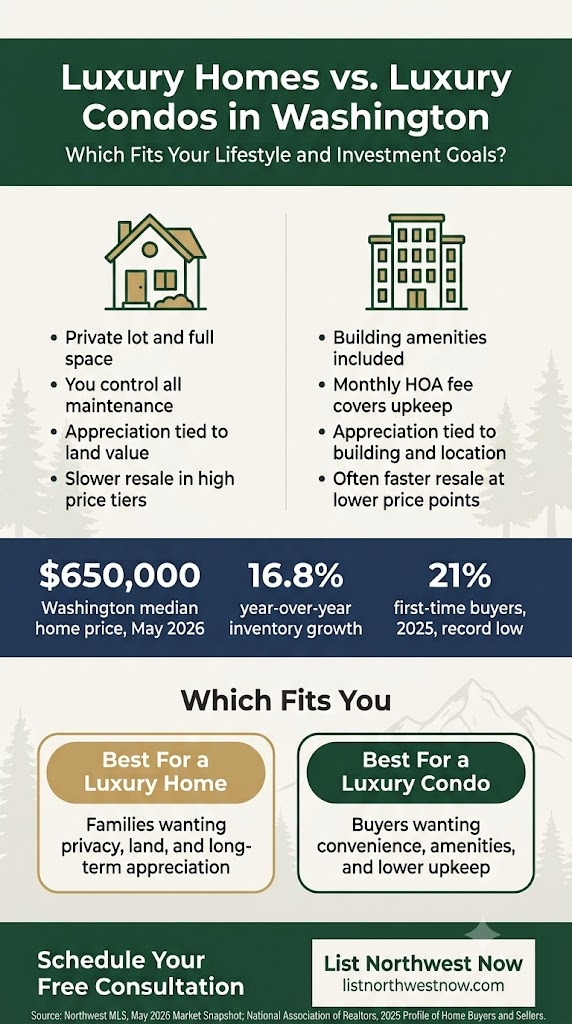
Quick Comparison: Luxury Homes vs. Luxury Condos in Washington
The right choice comes down to five factors: price, upkeep, space, appreciation, and how quickly you could resell if your plans change.
| Factor | Luxury Home | Luxury Condo |
| Typical entry price | Higher land included | Often lower per square foot |
| Ongoing costs | Property tax, insurance, private upkeep | Property tax, insurance, plus HOA dues |
| Privacy and space | Private lot, more square footage | Shared building, less outdoor space |
| Appreciation pattern | Tied to land value and lot size | Tied to building amenities and location |
| Resale liquidity | Slower in high-price tiers | Often faster due to lower price point |
“Washington’s median sales price for residential homes and condominiums reached $650,000 in May 2026, with active inventory up 16.8 percent year over year, according to the Northwest MLS Market Snapshot,” a shift that gives buyers more room to negotiate at every price tier.
What Luxury Homes Offer Buyers and Investors in Washington
A luxury home gives you land, privacy, and a property type that historically holds value through lot size and location, but it comes with full responsibility for maintenance.
This property type typically includes a private lot, more square footage, and full control over renovations. You cover all maintenance yourself, but you also keep 100 percent of any value you add. For buyers holding a property for 10 years or more, this control often produces stronger long-term returns.
Space, Privacy, and Land Value in Washington’s Luxury Home Market
Buyers who choose a luxury home usually want a private lot, mature landscaping, and a layout with no shared walls. In neighborhoods across King County and the Puget Sound region, lot size, and view corridors drive a large share of the price premium.
You get more control over how the property looks and functions, since no homeowners association can restrict your renovation plans.
Long-Term Appreciation Potential of Single-Family Luxury Homes
Single-family luxury homes tend to appreciate with both the structure and the land beneath it. Because land in desirable Washington neighborhoods stays limited, this dual value driver often supports steadier long-term appreciation than a condo unit alone.
Investors who plan to hold for multiple market cycles frequently favor this stability over faster but shallower condo turnover.
Who a Luxury Home Fits Best
A luxury home fits families who want space for children or guests, buyers who plan to renovate or expand, and investors who want direct control over a property’s long-term value. It also fits anyone who wants zero shared walls and no association limits on how you use the home.
What Luxury Condos Offer Buyers and Investors in Washington
A luxury condo gives you high-end finishes and building amenities with far less personal maintenance, though HOA dues become a permanent part of your monthly cost.
Amenities, Convenience, and Lower Maintenance Burden
Luxury condos in cities like Seattle and Bellevue often include concierge service, fitness centers, and secure parking that a single family home rarely offers at the same price point.
You skip roof repairs, gutter cleaning, and exterior painting entirely, since the building handles those tasks. This convenience appeals to buyers who travel often or want a lock-and-leave lifestyle.
HOA Structure and What It Means for Long-Term Ownership Cost
Every condo purchase comes with a homeowners association fee that covers building upkeep, insurance on shared structures, and amenity maintenance.
These fees rise over time, and a special assessment can add a large one-time cost if the building needs major repairs. Before buying, always review the HOA’s reserve fund and recent meeting minutes to see how well the building has planned for future costs.
Who a Luxury Condo Fits Best
A luxury condo fits professionals who want urban convenience, downsizing buyers who no longer want yard work, and part-time residents who split their year between Washington and another location.
It also fits investors who want a lower entry price point in a high-demand building.
The Key Differences That Matter for Washington Luxury Buyers
The real difference between these two property types is not the sticker price. It is how ongoing cost, appreciation pattern, and lifestyle trade-offs play out over the years you actually own the property.
HOA Fees, Maintenance Load, and Ongoing Costs Compared
A luxury home puts every maintenance dollar in your hands, which means unpredictable but self-directed spending.
A luxury condo replaces that unpredictability with a fixed monthly HOA fee, but that fee only covers shared spaces, not your unit’s interior. Run both scenarios over a 10-year hold before deciding which cost structure fits your budget.
Appreciation Patterns and Resale Liquidity by Property Type
Homes tend to appreciate through land value, while condos tend to appreciate through building reputation and location demand. This distinction matters most when you plan your exit.
“First-time home buyers fell to a record low of 21 percent of all purchases in 2025, according to NAR’s 2025 Profile of Home Buyers and Sellers,” which means a smaller pool of entry-level buyers may compete for lower-priced condos in the years ahead, affecting how quickly you can resell.
Privacy, Space, and Lifestyle Trade-Offs
A home buys you distance from neighbors and full control over noise, pets, and outdoor space. A condo trades that privacy for convenience and shared amenities you would otherwise pay to maintain yourself.
Neither trade-off is wrong, but very few guides walk buyers through both the cost side and the lifestyle side of this decision together, which is exactly the gap this guide fills.
These trade-offs carry real financial weight, which is why “Washington requires every broker and managing broker to hold an active license under Washington Administrative Code Title 308-124, per the Washington State Department of Licensing.”
Which Option Is Best for You?
Before you choose either path, verify that your agent holds an active broker or managing broker license with the Washington State Department of Licensing, can show specific knowledge of your target neighborhoods, and explains costs and timelines upfront.
First-time buyers and investors should also confirm the guidance is personalized, not one-size-fits-all.
Best for a Luxury Home
Buyers who want a private lot, full renovation control, and a property built for a long-term hold, such as a family relocating to the Puget Sound area or an investor targeting appreciation through land value.
Best for a Luxury Condo
Buyers who want lower maintenance, building amenities, and a lock-and-leak lifestyle, such as a professional working in downtown Seattle or an investor targeting steady rental demand in a high-occupancy building.
Frequently Asked Questions (FAQs)
Q1. Do I need a licensed broker to buy a luxury home or condo in Washington?
Yes. Washington law requires anyone facilitating a property purchase or sale to hold an active broker or managing broker license and follow fiduciary duties under Washington Administrative Code Title 308-124, per the Washington State Department of Licensing.
A licensed broker discloses material facts, explains timelines, and represents your interests through closing.
Q2. Is a luxury condo a good investment in Washington’s current market?
It can be, especially in high-demand buildings near job centers, but review the HOA reserve fund and fee history first. Condo appreciation depends more on building reputation than on land value, so building quality matters as much as price.
Q3. What is the biggest hidden cost of a luxury condo?
Special assessments. If a building needs a major repair and its reserve fund falls short, owners split the cost through a one-time assessment that can reach tens of thousands of dollars. Ask for the last three years of HOA meeting minutes before you make an offer.
Q4. How much more does a luxury home cost to maintain than a luxury condo?
A luxury home shifts all maintenance costs and decision-making to you, while a condo bundles most of that into a monthly HOA fee. Neither option is automatically cheaper. The total depends on the property’s age and how well the condo building manages its reserves.
Q5. Are first-time buyers priced out of Washington’s luxury market?
Nationally, first-time buyers made up a record low 21 percent of all home purchases in 2025, according to NAR’s 2025 Profile of Home Buyers and Sellers, and Washington’s high entry prices make this segment even tighter locally.
Working with a local expert helps first-time buyers find realistic entry points in both the condo and single-family markets.
Final Thoughts
Choosing between a luxury home and a luxury condo in Washington comes down to how you want to spend your time and build value ahead.
- Want land, privacy, and full control? A home fits your goals.
- Want convenience and lower maintenance? A condo fits better.
Either path benefits from a licensed local guide who knows current pricing and neighborhood appreciation trends.
Schedule a free personalized consultation with List Northwest Now to walk through your budget, lifestyle needs, and investment timeline before you make an offer.
Leave a Reply