

When you search for land investment opportunities in the Pacific Northwest, you get dozens of different answers. Some sources push vacant land as the smarter long-term play.
Others insist a built home is the safer, faster-moving asset. If you are not sure which one fits your goals, this comparison breaks down the real trade-offs so you can decide with confidence.
You will find land investment opportunities suit a longer time horizon and a lower entry budget, while a built home suits you if you want immediate use, income, or a faster resale.
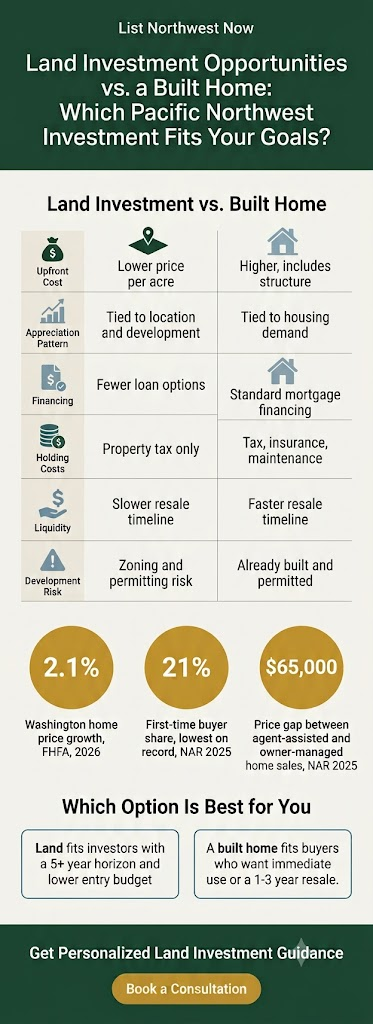
Quick Comparison: Land Investment Opportunities vs. a Built Home
You pay less upfront for land and carry fewer ongoing obligations, while a built home gives you faster liquidity and immediate use.
| Factor | Land Investment | Built Home |
| Upfront cost | Lower entry price per acre | Higher, including structure value |
| Appreciation pattern | Tied to location and future development | Tied to regional housing demand |
| Financing | Fewer conventional loan options | Standard mortgage financing available |
| Holding costs | Property tax only, minimal upkeep | Property tax, insurance, maintenance |
| Liquidity | Slower resale timeline | Faster resale timeline |
| Development risk | Zoning and permitting uncertainty | Structure already built and permitted |
“You can see in the FHFA Working Paper 19-01: The Price of Residential Land that residential land often appreciates at a different pace than the structures built on it, based on appraisal data collected between 2012 and 2019.”
That gap is a key reason land investment opportunities deserve a separate look from a finished home, even though the underlying dataset predates the current market.
“If you are weighing a built home instead, the FHFA shows U.S. home prices rose 2.1 percent year over year as of the second quarter of 2026,” giving you a clearer near-term appreciation benchmark than land typically offers.
What Makes Land a Strong Investment Opportunity
You get a lower entry point, appreciation tied to location, and fewer maintenance duties when you choose land investment opportunities over a built home.
If you are exploring land investment opportunities in the Pacific Northwest, you will generally pay a smaller upfront cost than buying a built home, since the price reflects the ground alone.
When you hold undeveloped land long enough to benefit from local growth and rezoning, you often see appreciation that a built home cannot match in the same timeframe.
Before you close on any parcel, check with the county assessor and planning department on the current zoning classification. Confirm perc test results for septic feasibility, since many rural Pacific Northwest parcels lack public sewer access, and that single detail can determine whether your land is buildable at all.
Long-Term Appreciation Tied to Location
Vacant land in growth-adjacent Pacific Northwest counties can appreciate significantly once nearby development, infrastructure, or rezoning activity increases demand for buildable ground. This pattern rewards you for patience rather than a quick turnaround.
Lower Entry Cost Than a Built Home
Because raw land does not include the cost of a structure, your entry price per acre is typically far lower than a comparable built-home purchase in the same area, making land investment opportunities more accessible if you are investing for the first time.
Fewer Ongoing Carrying Obligations
Undeveloped land generally requires only property tax and minimal upkeep from you, avoiding the insurance, utilities, and maintenance costs that come with owning a finished home.
A Documented Barrier You Should Plan Around
You are not the only one navigating this decision without full clarity.
“The 2025 NAR Profile of Home Buyers and Sellers found that first-time buyers fell to a record low of just 21 percent of all purchases in 2025, with limited market knowledge cited as a key barrier to entry.”
That barrier applies just as much to land investment opportunities as it does to home buying.
What Buying a Built Home Offers
A built home gives you a finished, move-in-ready property immediately, whether your goal is owner-occupancy or rental income. Financing is more accessible to you, since conventional and government-backed mortgage products are built around home purchases rather than vacant land.
Resale also tends to move faster for you, because more buyers feel comfortable purchasing a finished structure than raw acreage.
The Key Differences That Matter
The real difference between land investment opportunities and a built home comes down to financing, carrying costs, and how each fits your specific timeline.
Financing and Carrying-Cost Reality
Yes, you can finance a built home more easily through a conventional mortgage, but that convenience comes with higher monthly carrying costs, insurance, and maintenance that land investment opportunities simply do not carry.
Matching Land Investment Opportunities to Your Specific Goal
Appreciation timelines, holding costs, and liquidity needs rarely get compared side by side for Pacific Northwest buyers, which leaves many investors like you guessing rather than deciding with confidence.
“The 2025 NAR Profile of Home Buyers and Sellers also found that agent-assisted home sales closed at a median of 425,000 dollars compared to 360,000 dollars for owner-managed sales,” showing that guided transactions consistently outperform self-directed ones.
That same principle applies when matching land investment opportunities or a built home to your actual goal.
Which Option Is Best for You?
Land investment opportunities are best suited to you if you have a five-year-plus horizon, want a lower entry cost, and can accept a slower resale timeline while a location develops.
A built home is best suited to you if you want immediate use, rental income, or the ability to resell within one to three years without waiting on land appreciation or rezoning to play out.
Frequently Asked Questions (FAQs)
Q1. Are land investment opportunities a good option in Washington State?
Land investment opportunities can work well for you in Washington State if you have a longer time horizon, particularly in areas positioned for future growth, though appreciation depends heavily on location, zoning, and development timelines.
Q2. How does financing land differ from financing a built home?
Land typically requires a larger down payment and shorter loan terms than a built home, since lenders view vacant land as higher risk without a structure to secure the loan against.
Q3. What should you verify before pursuing land investment opportunities in the Pacific Northwest?
Confirm the broker or firm guiding you holds an active license through the Washington State Department of Licensing, ask whether they can demonstrate specific knowledge of your target area, and make sure the process is explained upfront.
Q4. How long should you hold land before selling?
Most land investment opportunities perform best when you hold them five years or longer, giving the surrounding area time to develop and demand to catch up with your purchase price.
Making the Right Call for Your Investment Goals
Land investment opportunities and a built home both have a place in your Pacific Northwest portfolio, but the right choice depends on your timeline, budget, and appetite for a slower-moving asset.
List Northwest Now offers personalized real estate consultation to help you weigh land investment opportunities against a built home based on your specific goals, not a generic checklist.
Book a consultation with List Northwest Now today to get expert guidance built around the Pacific Northwest market you are actually investing in.
Leave a Reply